
article
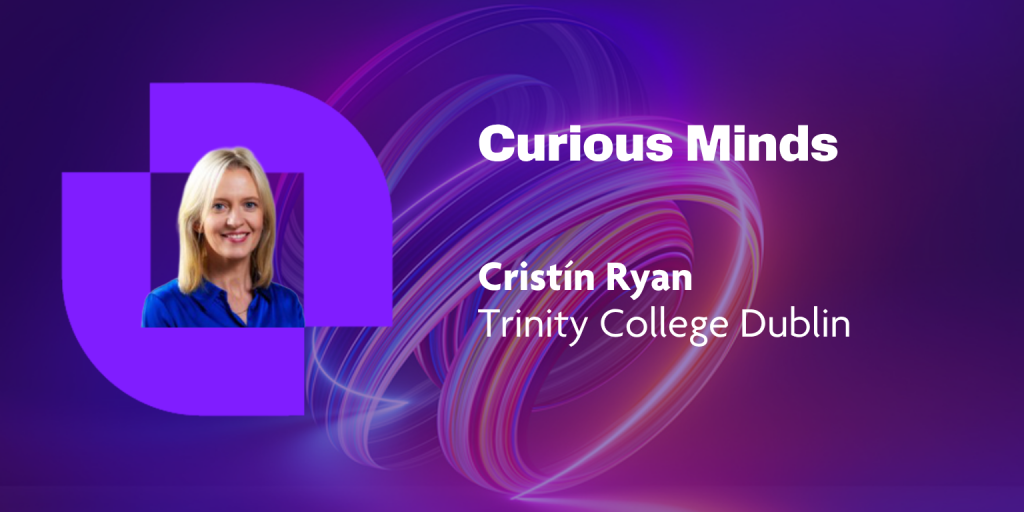
Curious Minds – Cristín Ryan, Trinity College Dublin
As part of our Curious Minds series, we speak to Cristín Ryan, a Professor in Practice of Pharmacy at Trinity College Dublin, Professor Ryan's research has contributed to pedagogy in pharmacy education including a research project with Learnovate to develop, test and refine a pharmacy education software solution which called AccuRxy.
- 5 min
What is your research about?
My research focuses on optimising medicines for patients, particularly vulnerable patient groups – making sure they’re getting the right medicine at the right time for the right condition, minimising adverse effects and drug interactions. During my training, I was introduced to a concept known as ‘pharmaceutical care’, which essentially defines a pharmacist’s contribution to care as one that should improve patients’ quality of life through the responsible provision of drug therapy, and this philosophy is what my research has been modelled on. Being able to do this is harder when we are treating vulnerable patient groups, for example those who have several medical conditions and are prescribed several medicines, or older, frailer patients. With an ageing population, multi-morbidity and polypharmacy are increasingly common. The more medicines someone takes, the more likely that there will be drug-drug interactions, drug-disease interactions, or even drug-gene interactions.
I study the risk associated with taking many different medicines at once, and help identify when certain medicines are unnecessary. I have developed practical checklists and tools that healthcare professionals can use to optimise patients’ drug therapy. I explore why patients struggle to take their medicines as prescribed and develop interventions to help them take their medicines as intended by their healthcare professional. I look at certain prescribing trends over time and track changes linked to new evidence and guidelines. I look at ways of improving research methodologies and allowing better comparisons between research studies. I’m also interested in how pharmacists are trained, and contribute to pedagogy in pharmacy education.
This interest in pharmacy education has lead to an ongoing research project where I and my colleague, Dr Cathal Cadogan, have partnered with Learnovate to develop, test and refine a pharmacy education software solution which we are calling AccuRxy. AccuRxy will provide a personalised and engaging learning experience for pharmacy students and will also be time saving for educators.
What is your favourite part about being a researcher?
I enjoy all of it. I love developing a research question and finding the answer, but I also love seeing our work implemented in practice, especially when it makes a difference to patient care. There’s no point in sitting at a desk doing the work I do if it doesn’t have an impact in real-world clinical settings. I also enjoy collaborating, meeting people from other disciplines – psychology, medicine, engineering – who challenge my thinking in different ways. That cross-disciplinary work is really stimulating. And then there’s the teaching side – shaping students’ futures, trying to inspire them to do more for their patients and profession. That’s very rewarding.
What is the biggest challenge AI presents for your research area?
AI is exploding right now. There are huge opportunities, but also a need for caution. AI isn’t as accurate as a human clinical brain, and that’s important to remember. Many students and pharmacists are already using AI to support their work, so the sensible approach is to use it carefully and critically. From a healthcare perspective, pharmacists can’t over-rely on AI because it’s not always right. It can quickly develop patient profiles and identify resources, but it needs to be used critically. Despite these challenges, I see significant opportunities for AI to improve healthcare and pharmacy education and medication safety. AccuRxy is an AI-powered medication safety platform we (myself, Dr Cathal Cadagon and other colleagues including members of the Learnovate team) are developing, where we are harnessing AI positively to enhance clinical education and frontline pharmacy practice.
In my own work, I use tools like Microsoft Copilot. I do a lot of evidence synthesis research, such as systematic or scoping reviews. AI can speed up aspects of that process. Some research students use it to develop search terms. In pharmacoepidemiology studies that involve analysing large drug databases, tools like Copilot, Gemini, or ChatGPT can be helpful in writing statistical code. It can really speed things up for researchers.
What advice would you give your younger self?
I’d say, ‘strive for excellence, not perfection’. There’s a tendency toward perfectionism in Pharmacy. Things don’t always need to be perfect. I’ve learned that excellence is about doing great work you’re proud of, while perfectionism is often just a fear of failure in disguise. Once you stop obsessing over every tiny detail, you actually find the freedom to take more risks and enjoy the work a lot more.
If you hadn’t chosen your current career, what would you have done?
I always wanted to be a primary school teacher. When I was doing the Leaving Cert, I went to a career guidance counsellor who asked me to fill out multiple questionnaires. When I’d finished, he examined them and advised me not to become a teacher and said that I should focus on science instead. I was devastated. I considered engineering because my brother was studying it in Galway at the time. A friend was going to Robert Gordon University in Aberdeen in Scotland to study pharmacy and I thought it sounded interesting so I filled out a UCAS form. I was accepted at the same time she was, and she encouraged me to join her – so I did. It was quite serendipitous. After university, I worked for a spell at the Royal Infirmary in Edinburgh where I got clinical experience in ward-based pharmacy. I didn’t know where I fit career-wise until midway through my PhD in Clinical Pharmacy at UCC. It was then that I realised I wanted an academic career, so I went back to Aberdeen to do post-doctoral research, after which I joined Queen’s University in Belfast as a lecturer in Clinical Pharmacy. I later joined Royal College of Surgeons as a senior lecturer in Practice of Pharmacy. I’m now at Trinity College. Pharmacy wasn’t the original plan, but I’m delighted with how it all turned out and where I now am in my career.
What do you think the future of learning will look like?
Exciting and terrifying at the same time. There are huge opportunities for inclusive and flexible learning, but educators must stay ahead of students in terms of technology. We need to teach students how to use AI responsibly and strengthen their critical appraisal skills. Despite challenges around attention spans and digital overload, it’s an exciting time for Pharmacy and for education more broadly.
Exclusive content for our members
If you're already a member, please sign in now to continue.
Or contact our team to find out more.