
article
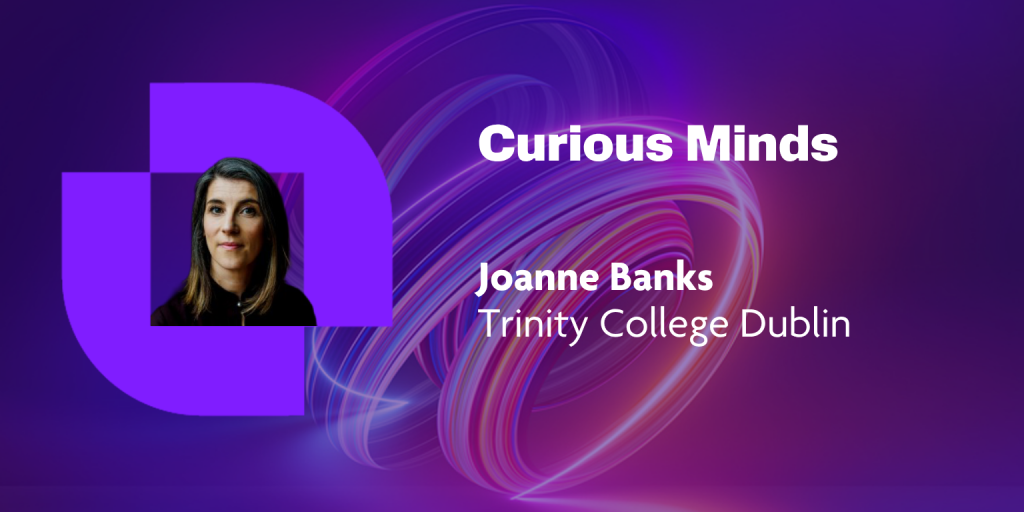
Curious Minds – Joanne Banks, Trinity College Dublin
For Learnovate’s Curious Minds series, we speak to Dr Joanne Banks, a lecturer and researcher in the School of Education at Trinity College Dublin (TCD).
Dr Banks began her academic journey with an undergraduate degree in Sociology and Geography at TCD. After graduating in 1999, she went on to earn an MA in Geography and a PhD in History from University College Dublin before beginning a 10-year career with the Economic and Social Research Institute (ESRI) in 2008.
It was while working with the ESRI that she applied her expertise in qualitative research to projects related to educational inequality, school exclusion, disability, special educational needs and inclusive education.
“It takes plenty of unexpected career twists and turns to go from Geography and History to research in inclusive education, but over the years I’ve really come to value my varied background. A series of happy accidents brought me here. It’s been a wonderful journey,” she says.
What is your research about?
My research focuses mainly on understanding the complexity of special and inclusive education and exploring the tensions within the policy space, society and the classroom. I also like to look at different education systems internationally and compare and contrast them with Ireland’s approach.
Since the mid-2000s, the priority for successive governments in Ireland has been to segregate students who have disabilities, separating them into special schools or special classes based in mainstream schools. That policy choice effectively others children who learn differently.
Ireland has signed up to international agreements that commit to providing students with a fully inclusive system in which every learner can access their local school alongside their siblings, their friends, regardless of whatever disability they might have. Yet, in practice, we’re expanding separate provision at pace, creating hundreds of new special classes every year. So we’ve got a mismatch: on paper we promise inclusion; on the ground we keep separating through the creation of a large special class and school system. The result is that families are pushed towards settings often away from their local school, and mainstream schools don’t get the investment they need to achieve an inclusive educational setting such as co-teaching, specialist support, accessible curricula, to include every learner.
My work explores various questions: why we’re in this position in Ireland, what does the future look like, what are the tensions and complexities in that space? I’m not at all saying the specialist provision isn’t required. It is. It’s more that the policy focus seems to be solely on separate provision even though the narrative at government level is that we’re seeking an inclusive system. There’s a conflict there and I like to get into that in my teaching and research.
What impact might your research have?
My work has two levels of impact, the first being the policy level. Recent research that I have undertaken has sought to better understand the inclusive education policy development process and more specifically how knowledge is exchanged between academia and policy. Indeed, my work at the ESRI was hugely relevant in terms of policy, so I’m always conscious of how my research can be influential in policy terms. A big part of that is creating awareness in the policy-making community. As an academic, it can be difficult to directly access people who are designing policy, even those who are seeking knowledge about the current debates on special or inclusive education. Equally, my research highlights difficulties for policy makers in easily accessing up-to-date research on good practice in special or inclusive education. That’s a big challenge.
The second area of impact of my research is on teacher education. I work on the Professional Masters of Education here in Trinity which aims to help teachers implement inclusive practices in classroom settings. A huge part of what I do is raising awareness and promoting a shift in attitude among student teachers and teachers who engage in learning. Key to that is getting them to consider the assumptions their school might have around children with special educational needs, which in turn might inspire some difficult questions among leadership, peers and colleagues, about whether students with special educational needs are being best served by the practices used in their school.
What I find is that my students often educate me about the reality of the classroom and I like to reciprocate by outlining the theoretical foundation of certain approaches, and the historical context for certain policies. This co-creation of knowledge between me and the students is a fantastic way to learn.
How do you go about gathering data for your research?
Since I’ve been at Trinity, I’ve put my energy into creating a community of inclusion experts by hosting them on a podcast I created called Inclusion Dialogue. I’ve turned each of the previous three series into books, so they can be accessed by people who aren’t necessarily audial learners. This project has been transformative. I’ve tried to gain a comprehensive insight into our understanding of special and inclusive education and diversity among students generally, and across different global contexts. Naturally, we take a very Western focus, but there are other economic and cultural contexts and studying them has made us more aware of our assumptions. For example, when we say “inclusive education”, what does that actually mean, what does it look like? The podcast has been my project over the past couple of years. I think it’s a very accessible resource for teachers, parents, students, advocates and policy-makers.
Is there a country or region that’s doing inclusive education well?
A guest on my podcast, Professor Richard Rose from University of Northampton, cautions against that idea of holding up one approach as an archetype. He emphasises the need to be context specific in our understanding of inclusive education. Bangladesh can’t adopt an Irish inclusive system, for example, because there are many differences related to culture, organisation, even the physical infrastructure of our schools, that prevent you from transposing systems.
There are several regions around the world that have fully inclusive and equitable systems, like New Brunswick in Canada, Italy and Portugal. Other guests on my podcast have been Gordon Porter and Jody Carr who were directly involved in the implementation of inclusive education in New Brunswick. My main take-away from their interview was the enormous policy commitment required to make it happen back in the early 1990s. Italy and Portugal have very limited specialist provision available in their education systems and children are automatically entered into a mainstream school regardless of ability. Doing a similar thing here in Ireland, would mean dismantling the current system and moving from our parallel systems of mainstream and special education to a whole school inclusive model of education. Despite a policy commitment to this kind of model in the future, the current practice is the expansion of special classes every year across the country. It can be difficult to directly compare.
When working with students, we examine what are called the medical and social models of disability to understand this dilemma here in Ireland and other national contexts. In plain terms, the medical model says the ‘problem’ is with the child or young person and tries to fix them. The social model says the problem is in the barriers and asks us to fix the environment including access to education, teaching and learning, assessment, and attitudes and mindsets. That cultural shift is particularly important within school leadership where there is a vision that the school is for every learner regardless of ability. Where countries have adopted an inclusive approach to their education system, this is underpinned by the social model of disability.
What is your favourite part about being a researcher?
I enjoy seeing perspectives change over time. I’ve been researching educational inequality and disability special educational needs for about 17 years. In that time, perspectives have shifted quite significantly, which trickles down very slowly to the classroom level. What I’ve found working with my students is that inclusive education is often just good teaching. A lot of the time, they’re ‘doing inclusion’ already without even realising it. Some ask, ‘How do I become a more inclusive teacher? How do I implement more universally designed classrooms?’ And when you chat with them you find that they’ve achieved it through good, inclusive and empathetic teaching practice. Every child is included, and there’s choice and flexibility built into a lot of what they do. For the teacher, that’s a huge relief because they realise that there’s not some great mountain they have to climb to become equipped to teach a diverse student body.
What advice would you give your younger self?
Things tended to unfold before me and opportunities arrived as a series of happy accidents. The best parts of my career arrived as happy accidents, and a few big disappointments turned out to be blessings. The way my career has panned out, I feel so fortunate to be working in this job with such amazing colleagues. Mostly that’s the result of trusting that things fall into place.
What’s the best advice anyone has ever given you?
Don’t be afraid to try something, even if it’s not perfect. Just go for it as best you can with the resources you have. The podcast was a nerve-wracking thing for me. I was putting myself out there in a way I never had before. If I hadn’t done it, I would have saved myself potential disappointment, but I would never learnt so much, had so many great conversations, and met new colleagues and friends.
What is the biggest challenge AI presents for education?
From a special education perspective, AI can offer students great support. Before, we had assistive technology which went some way towards creating a more level playing field for students with disabilities. For some students, AI can help them get to the more substantive elements of their work without getting mired in things like formatting language text.
I often ask students to put their assignments into AI and then grade the content that comes back. They are going to be teachers. Their students are going to be using it. I want them to critique the quality of the AI output. I find the level of AI output shockingly bad with a really poor level of insight. For many, it’s a real eye opener to learn that the AI actually isn’t saying anything. As the technology becomes more sophisticated, there is obviously a risk in terms of assignment-based study.
What AI tech impacts your life the most?
Most of the time I’m using AI, I’m critiquing how poor it is. If I’m using it for idea generation, I find what comes back quite insipid. Its usefulness possibly lies in how well you interrogate it. Working in teacher education, AI has to be front of centre of discussions around teaching, learning and assessment both in higher education but in schools as well. We cannot ignore it. Instead I think we need to create awareness, debate and discuss and collectively understand its implications for education in the future.
What do you think the future of special education will look like?
It’s going to be very hard to undo the structure we’ve put in place regarding special education in Ireland. Parents of students with special educational needs and disabilities are understandably frustrated by the lack of supports with many in a role of lifelong advocacy for resources for their child. Parents want the optimum educational setting for their child and that’s often special education when the only other choice is placement in mainstream education. To achieve an inclusive system there would need to be root and branch reform to understand where students with disabilities are meaningfully included in class, meaningfully engaging with the curriculum, and where teachers have confidence and capacity to teach every student in the class.
I think that Ireland is at a crucial point in its inclusive education reform journey. With our diverse school population, we require a major cultural shift around how we perceive difference and respond to student variability in our schools. I think it’s now the time to identify the problems in special education, examine the possible solutions with a focus on how we can universally design our education system to respond to an increasingly diverse student population. Despite the varied views among parents and education stakeholders, we all agree on one thing: that children and young people should be meaningfully included and have a sense of belonging in their local school.
Exclusive content for our members
If you're already a member, please sign in now to continue.
Or contact our team to find out more.