
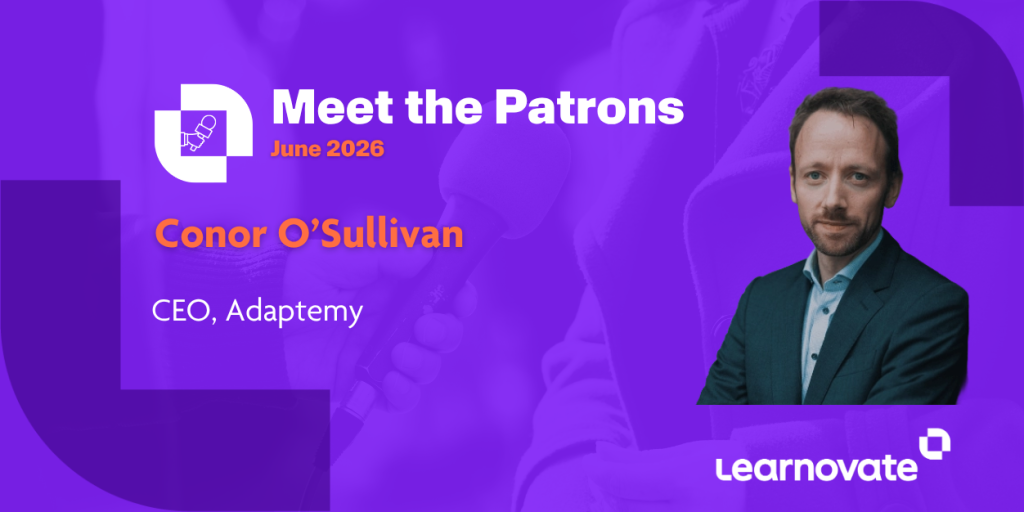
Meet the Patrons
Meet the Patrons interview with Conor O’Sullivan
For the latest in our Meet the Patrons series we speak to Conor O’Sullivan, CEO of Adaptemy, a Dublin-based EdTech company that creates intelligent, adaptive learning products for education providers. Conor is also the current Executive Chairman of Folens Publishers, having previously served as CTO of the organisation from 2008 to 2012, and is a Non-Executive Director of Hibernia College.
- Meet the Patrons
What are the biggest lessons you learned in your career?
Anticipating what’s going to happen is important, but what’s equally vital is sustaining your company for long enough so that it can be around to exploit opportunities when they finally arrive. Timing is such an important factor – by which I mean understanding that markets often move slower than you think they should and then, suddenly, much quicker. The world doesn’t change in 18 months just because you have an idea.
How would you define your work style and how has this changed over your career?
As researchers, we’re naturally curiosity-driven, explorative, always trying to think of things in terms of first principles and question as much as possible. How that evolves in an organisational context depends on its leaders. At Adaptemy, we’ve created an environment in which teams have freedom to think things through and explore ideas. We try to empower people, get to know their skills and personality types, and what makes them individually strong or weak. Key to that is culture. How do you create culture? You try to embody the values of the organisation yourself so that when there are challenges and conflict, you can navigate them with values as your guide. Obviously culture isn’t a cure-all. A culture that’s enabling and multiplying for one person might strangle somebody else, but if you get it right, it can do a lot of work for you.
What advice would you give to your younger self?
Don’t take advice, just be curious, confident, and try things yourself. The education system I went through didn’t encourage confidence or questions. If I was going back to redesign my education, I would promote curiosity and dialogue, rather than simply absorbing information.
If you hadn’t chosen your current career, what would you love to do instead?
I love creating things, so I would say that I’d be involved in carpentry or architecture – music as well. I play the piano but that’s something I just love doing as opposed to making it a career.
How is AI impacting your organisation/industry?
Everything we were doing a few years ago revolved around old-fashioned, pre-ChatGPT AI. Machine learning and deep learning was about matching patterns to build models. We positioned ourselves as the company that could introduce that type of AI to our clients. LLMs arrived later and have been transformative for Adaptemy. Almost overnight, personalised learning became much more powerful because you could engage and have conversations with a virtual tutor. Our partners are now taking the machine learning-based technology and adding an LLM to create fantastic products. It’s incredible to work with product managers on these projects. AI is influencing content production too – in terms of quantity, quality, and variety. For personalising learning, there should be loads of different ways to learn, so there needs to be more variety. Where previously that would have been a bottleneck in terms capacity and cost, AI has helped overcome those barriers.
What are the opportunities from AI to your business?
Our ability to scale is far greater now than a few years ago. Previously, our customers would have been a smaller set of ambitious companies with dedicated budgets. Fundamentally, AI has enabled us to sell to more companies. Also, the appetite of the public and market for AI-enabled solutions has increased – that’s a big driver for us. Another thing that’s changed is the expectation among the public of what learning should be and the skills people need to develop.
Why is R&D important to your organisation?
We started as an R&D company. We’ve received close to €15 million in EU funding for various university collaboration projects over 10 years. That was huge for us. Over the years we’ve become an R&D arm of our clients’ companies. We then prototype new ideas for them on contracts, because that’s what we’re used to doing.
What new trends or technologies are changing how people learn?
The broader focus on developing richer models is what’s driving our research into how learning happens. There was a feeling in EdTech circles that learning was becoming this isolating thing, just you and your laptop. That can be effective from a pure memorisation point of view, but recently there’s been a lot more emphasis on getting a deeper model of each learner from their affective or emotional side, the peer social side, and the benefit of the social aspect of learning to learning itself.
What book would you recommend on learning, technology, or business?
How We Learn by Stanislas Dehaene. It’s a pop learning research book that’s very interesting for anybody in education, just to get an overview of the learning science in layman’s words. It deals with things like what gets your attention, what makes you curious, and gives you a better idea of how we learn by bringing learning science to life.
The Range by David Epstein. It’s an argument against over-specialising in a certain area and says that people who are more generalists are better equipped to tackle the wide array of problems in modern society. It’s in opposition to the 10,000 Hours Rule espoused by Malcolm Gladwell, which explicitly argues for specialisation. It’s a really interesting book.
Why is membership of Learnovate important to your company?
Learnovate brings together the research and university sides of EdTech with the business support side. Having a forum that ties the industry community to Enterprise Ireland and the research community is what makes Learnovate unique.
Exclusive content for our members
If you're already a member, please sign in now to continue.
Or contact our team to find out more.