
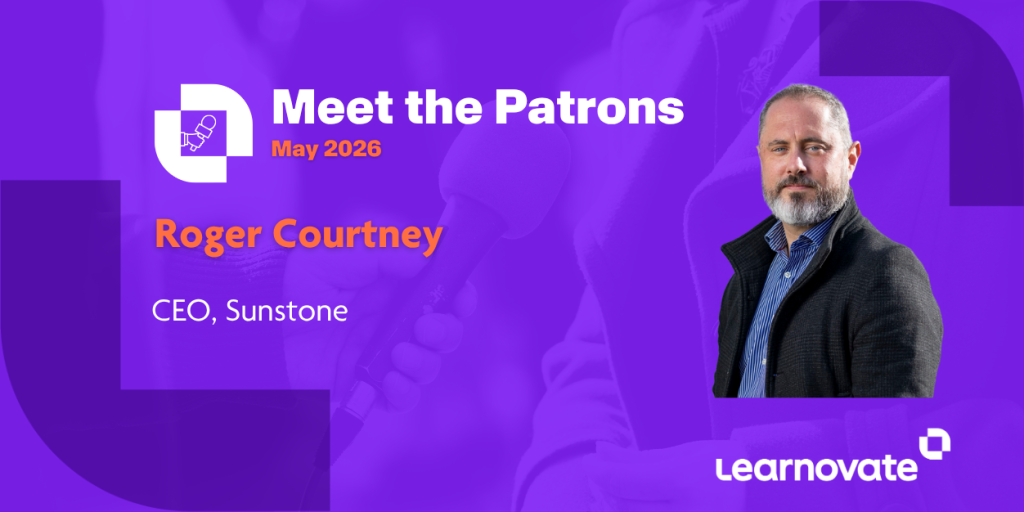
Meet the Patrons
Meet the Patrons interview with Roger Courtney, CEO of Sunstone
As part of our Meet the Patrons series, we speak to Roger Courtney, founder and CEO of Sunstone, a proprietary market analysis platform for businesses.
- 4 minutes reading time
- Meet the Patrons
Roger founded Sunstone alongside partners Zachary Clark and Aisling Ní Mhuirí in 2023 after finding that the system for company classification was highly inaccurate and unreliable. Using machine learning, the company set about developing its bespoke MAPS technology to collect open-source data with the aim of creating a more precise classification system in which organisations can make better strategic decisions.
Roger’s career spans private equity and entrepreneurship across a variety of industries. He was Executive Director of Kilcullen Kapital Partners from 2014 to 2024, during which time he founded the film production company Fever Kid Films and served as a Board Member of The Sunday Business Post and Managing Director of Bill Moss Data.
What are the biggest lessons you learned in your career?
It will always take a little longer. It will always need a little more work. The finish is always just over the horizon. Keep going. Keep working.
What do I mean by that? At some point you’re going to think your product is ready – however, the reality is that your product is not ready. Later, you’ll think it’s really ready – it’s definitely not ready. Later again, you’re going to think it’s totally ready – it’s not going to be ready. Keep going. Keep improving.
Expanding the potential of Sunstone’s MAPS technology has taken more time than expected, but we’ve been rewarded for our patience in that we’re able to do much more now than we were six months ago. For example: we have a client that is the CEO of a food manufacturing business. In order to provide them with greater insight, we are now able to look at the menus of every single restaurant, takeaway and deli that operates in Ireland so they can get a perfect understanding of their company’s market fit. We couldn’t provide that level of insight in September 2025, when I thought we had a finished product. We can now.
Keep working on whatever it is that you’re doing. If you keep improving something 10% every six months, pretty soon there’s a compound effect.
How would you define your work style and how has this changed over your career?
I used to chew up difficult tasks and spit out completed work. That was how I built my sense of value through work. My biggest challenge was transitioning from being a doer to a communicator. I don’t have the technical skills and capabilities of my team, so my job is to transfer my ideas into the heads of other people, helping them understand so we can build it together.
What have you learned about managing teams and individuals?
Surround yourself with good people – that’s the starting point. If you have good people around you, it’s easier to trust and let things go. I think that’s where a lot of people struggle. I’m very lucky in that I assembled a brilliant team of people who I trust implicitly. Collectively, we have a really great understanding.
What advice would you give to your younger self?
Be yourself. In previous roles, my job was to be in the background, suppress myself and never look for credit. What I’ve discovered is the more authentically “me” I’ve become, the faster I’ve progressed and the higher I’ve climbed.
If you hadn’t chosen your current career, what would you love to do instead?
I’d be doing carpentry. I’ve built all kinds of things. Recently I built a working electric guitar with a sterling silver pickup and a sterling silver inlay in the fretboard as well. I’ve even built a rocking chair. I build stuff all the time.
How is AI impacting your organisation?
AI has a substantive role in our work. What makes Sunstone unique is that we’re the only company that’s gone through the entire Companies Registration Office (CRO) database year by year, company by company, line by line – empowered by machine learning and AI – and reclassified and recategorised the entire thing. We’re the first company to have done that, in any country.
We build in machine learning for data collection, classification and categorisation because we need to have confidence in the accuracy of the data. Most AI tools are produced inside a black box, so it’s difficult to audit the track of information. For example, if a tool turns X into Y after putting it through Z, it’s not trustworthy if we don’t know what happened inside Z. That’s why we build our own tools.
The AI gathers information from various sources – from statutory bodies that require accurate reporting to firmographic information, which is basically everything about a company that’s published on the internet, like their website, social media, reviews, market position, and where their products can be found.
That level of detail increases the scope of insight and analysis we provide clients.
What are the risks from AI to your business and the sector?
The greatest risk from AI to Sunstone is the proliferation of low-grade, bad data that is being offered by companies who are presenting it as the gold standard. The risk is that will undermine faith in data as a reliable source of strategic information.
Sunstone sells data that we have validated, verified, checked on every primary research site. So, when we validate the entire CRO, we’re not selling data for people to go out and make sales calls. We’re selling strategically empowering information that can allow companies to build three- and five-year plans reliably, understanding the full scale and scope of their market because they can see all of them, all at once, at scale.
Why is R&D important to your business?
Everything we do is R&D. The technology we built to reclassify the economy is brand new and proprietary and has allowed us to create a scientifically measurable, quantifiable, quantitative measurement of a company’s market coverage. We call it a bespoke addressable market.
Typically, companies are put into generic categories like “retail” rather than what they actually are, like “independent coffee shops in urban areas”, for example. Imagine a company’s client set is 200. If we correctly and precisely categorise those companies, we might end up with 100 micro categories. If we take those 100 categories, turn them into buckets, and then fill them with every other company in the country that trades in those same sectors, we have two sets. Set A, the companies you sell to, and Set B, the companies you don’t sell to but that trade in the same sectors as the first set. A plus B is a bespoke addressable market. A divided by B is your market coverage.
Average the balance sheets of A and B. If one is lower than the other, you sell to the low end of the market. If one is higher, you sell to the high end of the market. All of these are strategic signals telling you that if you sell to the low end of the market, you should launch a premium offering to move upmarket. If you sell to the high end, launch a generic offering to expand downmarket. The entire point is to show you where you could be trading, but aren’t.
What are the biggest skills challenges in your business?
Our team’s experience is mostly on the data side where we’ve been very lucky to not experience too many challenges in terms of recruitment. Personally, I’ve been very lucky in that I met my co-founders, Zach Clark and Aisling Ní Mhuirí, during my previous roles – Zach when I joined Bill Moss Data as Managing Director in 2021, Aisling during my time as a Board Member of The Sunday Business Post. Since then, we’ve added a great COO in Emma Cooke, and we’ve just recruited David Connolly, formerly of Stripe, as CTO. They’re very, very talented people and make up a team of A players. We’re only beginning now to recruit on the commercial side of the business.
Why is membership of Learnovate important to your company?
Our membership of Learnovate is extremely important to us for a range of reasons.
Firstly, one of the best people in our company, Rohan Mohite, was recruited through the Learnovate Work Ready Graduate Programme. He’s been vital to our development of tools in machine learning.
Secondly, what we’re doing is completely novel. We’re practitioners, not academics. We need Learnovate to guide us in terms of shaping the material so we can communicate it effectively. Ultimately, we’re creating a new way of looking at economics and that will put new demands on third-level education sector in particular. Learnovate is helping us grow into our role and is a valuable partner in terms of facilitating collaboration and networking.
Thirdly, Learnovate is a fantastic networking hub. The Learnovation Summit, in particular, puts us in the room with lots of interesting people that we’ve worked with in the past.
Exclusive content for our members
If you're already a member, please sign in now to continue.
Or contact our team to find out more.