
Project

Investigation into Rewards and their effects on Student Motivation in Blended HE

This report synthesizes psychological, neuroscientific, and experimental research to evaluate how tangible rewards impact student motivation and sustainable learning behaviours in blended higher education.

Back to projects

Overview

This report examines whether tangible rewards can effectively promote sustainable learning behaviours and academic motivation in blended learning higher education (HE) students, without undermining intrinsic motivation. It reviews experimental studies, meta-analyses, and interdisciplinary perspectives from psychology and neuroscience.

Key Findings

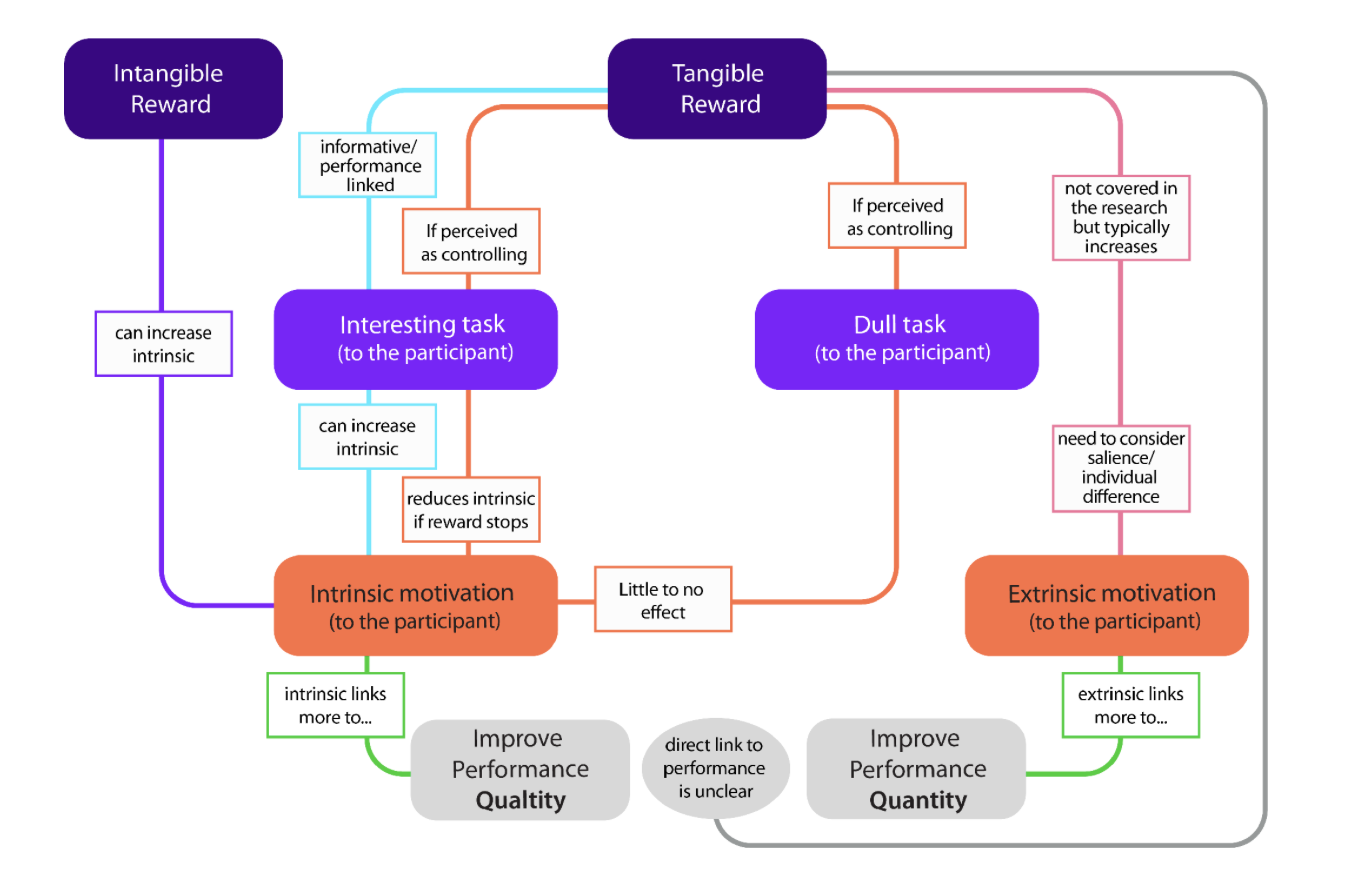
  • Self-Determination Theory (SDT) and Cognitive Evaluation Theory (CET) predict that tangible rewards, especially when perceived as controlling, can reduce intrinsic motivation for interesting tasks. However, empirical evidence shows mixed results. Note the inclusion of ‘interesting tasks’ is important here as it narrows the scope of the effect, and has implications for higher education where many courses may not be viewed by students as interesting.
  • Experimental HE studies (Xiao et al., 2024; Bai et al., 2021) found that tangible rewards: – Increased intrinsic motivation, behavioural engagement, and cognitive engagement. – Boosted knowledge construction in online forums. – Did not significantly harm learning performance, though no strong gains were found either.
  • Achievement-based reward research (Cameron et al., 2014) showed that performance-linked tangible rewards (cash) could increase intrinsic motivation, even for tasks typically at risk of “undermining.”
  • Meta-analyses reveal a nuanced picture: – Cerasoli et al., 2014: Intrinsic motivation best predicts quality; extrinsic incentives best predict quantity. Both can work together if well-designed. – Jenkins & Shaw, 1998: Financial incentives (in the workplace) consistently improve performance, especially quantity, without inherent undermining. – Deci et al., 2001: Tangible rewards can undermine intrinsic motivation for interesting tasks if they are perceived as controlling; less risk for dull tasks or when rewards are informational.
  • Neuroscientific insights (Hidi, 2015) show: – Both intrinsic and extrinsic rewards activate similar brain circuits. – Reward anticipation, active earning, and individual differences strongly influence effectiveness. – Social rewards and choice can function as powerful motivators alongside tangible incentives.

Recommendations

  • Design rewards to be informational, not controlling
    Link rewards to demonstrated competence or achievement, and frame them as feedback rather than coercion.
  • Match reward type to task goal
    For quantity-based outcomes: tangible rewards can be direct and performance-linked. For quality-based outcomes: emphasise autonomy, creativity, and intrinsic interest.
  • Use tangible rewards strategically
    Deploy them in contexts where tasks are less inherently interesting or to spark initial engagement.
  • Integrate social and intangible reward
    Combine material incentives with recognition, public praise, or status markers for a broader motivational impact.
  • Consider learner diversity
    Tailor reward structures to individual differences in reward sensitivity, task interest, and cultural context.

Conclusion:

Tangible rewards, when carefully structured and aligned with learning objectives, can support engagement and certain performance outcomes in higher education without necessarily undermining intrinsic motivation. The key lies in design, framing, and context—balancing extrinsic incentives with the preservation (and where possible, cultivation) of intrinsic interest.


Research Outputs

This concept is based on the idea that authentic learning experiences incorporate challenges across multiple different levels.

Investigation into Rewards and their effects on Student Motivation in Blended HE.

This report synthesizes psychological, neuroscientific, and experimental research to evaluate how tangible rewards impact student motivation and sustainable learning behaviours in blended higher education.