
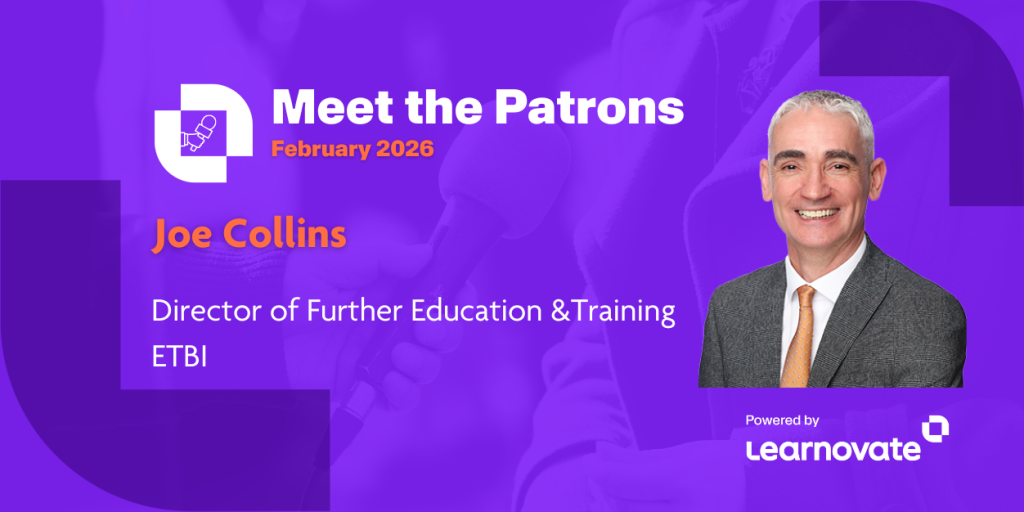
Meet the Patrons
Meet the Patrons interview with Joe Collins
Joe Collin, a Patron member of Learnovate, spent much of his career at South-East Technological University, where he was Head of the Faculty of Business and Humanities, and Head of the Faculty of Lifelong Learning. In 2023, he joined the ETBI on a three-year secondment.
- Meet the Patrons
As part of his role, Joe works with government departments, industry, community organisations and international partners to align Further Education and Training provision with national policy. He also drives quality and innovation in the sector and supports strategic reform, all while raising the profile of the sector.
What are the biggest lessons you learned in your career?
Collaboration is everything, especially when you’re a representative body trying to speak with one voice for 16 autonomous education and training boards. The most impactful work happens when people share a vision and build and work together. Another thing I learned from one of my mentors along the way was to not wait for perfect conditions to make a start. Progress is often iterative. I’m a real believer in seizing the moment.
How would you define your work style? How has it changed over your career?
My approach has evolved from early in my career when I was hands-on and detail-focused, especially in terms of operational delivery. As I’ve progressed, I’ve moved into more strategic leadership roles which have been more about delegation, trusting in your team, enabling rather than directing.
I’ve always valued structured thinking and strong communication. I’m very focused on outcomes. But I’ve also had to become adaptive over the years due to the pace of change in education in terms of digital reform, policy reform, stakeholder complexity. All of that teaches you to be more agile and comfortable with ambiguity.
Another shift has been how I manage time and energy. So I’ve moved from a reactive mode to a more proactive rhythm. Key to that is making time for thinking, not just doing. That’s made me more resilient and more effective.
What advice would you give to your younger self?
Don’t be afraid. Be curious. Ask loads of questions. Build networks early. Don’t regret afterwards.
If you hadn’t chosen your current career, what would you love to do instead?
I would love to have done something in the legal or medical profession. My impression is that legal training helps clarity of thought and the ability to make very clear arguments and make change. As life progressed, I became very involved in the care of my late parents. That showed me a very different side of work. I have huge respect for the medical and caring professions.
How is AI impacting your organisation/industry?
Because it can transform how we deliver and assess learning in the future, we cannot afford to stick our heads in the sand. We’re still in the early stages of adoption as a sector, but the potential is enormous. It can personalise learning for our learners, help with curriculum design, administrative efficiency, and with developing smarter ways to support learners through learning platforms, data analysis, and automation tools.
I hope it’s prompting us to rethink the skills we teach, because there’s a growing emphasis on AI literacy, critical thinking, ethical awareness – ensuring that learners aren’t just users of technology, they are informed participants in a digital society.
What are the opportunities and/or risks from AI to your business or sector and/or the learning technology industry?
Keeping curriculum up to date is a continual challenge for the sector. AI has a huge role to play in that, it just needs to be a managed process. Technology is also making us rethink the need for rote learning in the traditional sense. When I was in school, there was a huge emphasis on rote learning. Now, we need to think differently, because the skills that are needed for the modern world are very, very different. AI has an awful lot to help us with there, too.
What new trends or technologies are changing how people learn? How is your organisation responding to this?
Learning is becoming more learner-centred and flexible. There’s a real shift towards micro-credentials – bite-size learning that allows people to upskill or reskill around their work. AI is transforming how content can be delivered and assessed. There’s a massive focus on skills and work-based learning. With apprenticeships and traineeships, industry partners are playing a bigger role than they’ve ever had before.
There’s a real emphasis, too, on inclusion and accessibility in terms of providing literacy supports and pathways for learners from socio-economic disadvantage.
What are the biggest skills challenges in your business or sector?
Employers have been saying that they’re struggling to find people with the right mix of technical transversal skills, especially in construction, healthcare, and ICT. Technology can play a part in bridging that gap because the pace of change is such that additional qualifications alone aren’t enough. Attracting and retaining talent are challenges in the sector – learners entering key sectors, and educators staying in the system – while another might be embedding soft skills, like communication, teamwork, resilience, adaptability. They’re increasingly vital, but they can be harder to teach and harder to assess. That’s what we hear a lot, particularly from industry. Cumulatively, the challenges require a coordinated response, in terms of policy and pedagogy.
How can third level address the skills gaps/challenges you are facing?
We all know that third level is fantastic, but it’s not the be all and end all. We’ve a slight imbalance in recent years in which up to 70% of students are going into higher education from second level. The European average is about 50%. We’re now beginning to see the impact of that, particularly in terms of societal needs around the skills mismatch. There’s a massive opportunity for further education and training and higher education to work together to be much more flexible to create programmes that reflect real-world needs.
Why is membership of Learnovate important to your company? What does Learnovate do well?
It’s important to bridge the gap between research and practise. Learnovate helps us to stay connected around innovation for design, technology, and learning that’s relevant to us. We’re in the business of education, so naturally we have to be in the business of reflection and learning.
Exclusive content for our members
If you're already a member, please sign in now to continue.
Or contact our team to find out more.