
Meet the Patrons
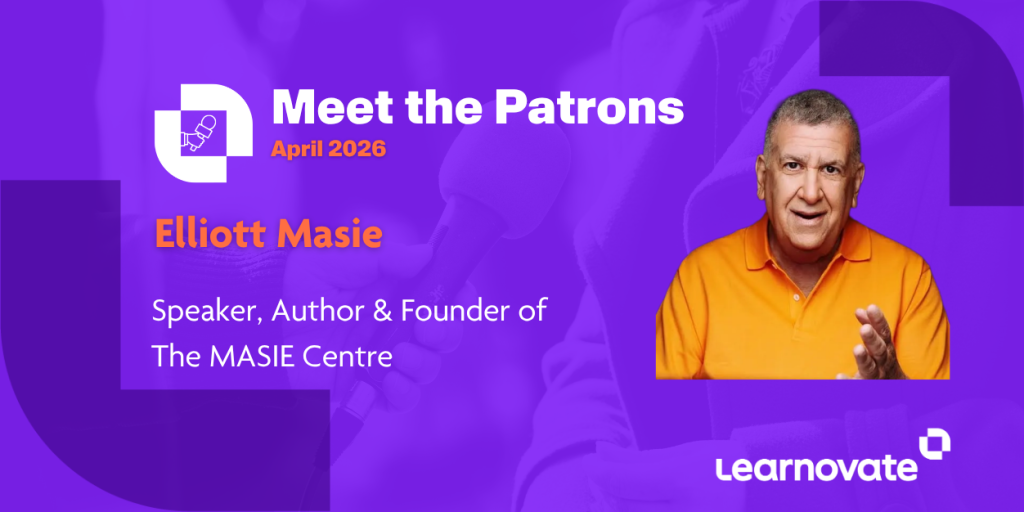
Meet the Patrons interview with Elliott Masie
As part of our Meet the Patrons series, we speak to Elliott Masie of the Masie Learning Foundation based in Saratoga Springs in New York.
- 4 minutes reading time
- Meet the Patrons
Elliott is a leading expert in workplace learning, educational technology, and the future of training. The founder of The MASIE Centre, a think tank focused on how organisations use technology to improve learning and knowledge sharing, Elliott has over several decades, advised the public and private sector institutions on learning strategy, e-learning and digital learning. He is a keynote speaker, author, CEO of MASIE Productions, bringing Tony-nominated musicals and dramas to Broadway and stages across the world.
What are the biggest lessons you have learned in your career?
There are two lessons.
The first is that learning is organic. To learn, I usually have to have a desire to learn. We have to be in the right moment and be in an environment of trust. We don’t really memorise anymore because we search for whatever we want to recall. On the flip side, when we learn something new, we are linking it to everything we know already. That’s organic learning.
The second lesson is that every learner should do some teaching practice. I once interviewed the former CEO of General Electric, Jack Welch, and he said he needed to go into work every day, learn something from another employee, and teach something to a different employee. He said, “That’s my job, and I want that to be the job of everybody at General Electric”. Teaching is part of the learning process.
How would you define your work style and how has it changed over your career?
My entire work globally is done on my MacBook. I don’t call it work from home. I call it work from everywhere or anywhere. I write in the morning. I go to Café Nero and drink an iced latte and eat an apple and write from 7:15am until 8:15am. In a previous life, we built a million dollar office and headquarters.
Now, my work has changed because I have had a Lego-model career. I worked as an entrepreneur and as one of the innovators in the world of learning technology.
Twenty years ago, my wife and I decided we also wanted to become Broadway producers. It doesn’t look like they fit, but they do, because they’re both about storytelling. In the future, as technology and work evolve, more people will have a range of Lego-block careers.
What advice would you give to your younger self?
Most people, when they start a job, decide within the first three days how long they are going to stay in that role. I was actually fired from my second job. I never was an employee after that. I ran my own company or I was a research fellow. I think that was because I really value mistakes. As an employer, I never punish people for making a mistake. It’s necessary. If I had advice for my younger self it would be to make more mistakes.
If you hadn’t chosen your current career, what would you love to have done instead?
I had three careers I wanted to do. I wanted to be an astronaut, a tour guide, and a monk.
First, I wanted to go to space but at 75 I think my chances of that now are slim. I love taking people to places they’ve never been and showing them things, so tour guide is an option. And lastly – I’ve thought about this one over the last couple of months – is that I think I would like to live in a very monastic way.
What would it be like to be a monk? I’m not religious, but I followed recent media reports of a group or monks walking quietly across America and I was fascinated by it. What would that experience would be like?
How is AI impacting the learning technology industry?
AI is a technological tidal wave, a large amount of energy coming toward you that you didn’t anticipate and you’re not quite sure what to do about, but you can’t ignore it.
I recently asked an AI to brief me on the background of a murder of a gang leader in Mexico. I got a very interesting summary and it said, “From your previous conversations, I know you served in an advisory role to the US government looking at foreign policy and intelligence, I’ll give you the data the way you would have received it as an unclassified briefing”.
It did it very much the way I would get from the US State Department. That tells me that we ought to be looking at AI as impressed and fascinated, and maybe sometimes cautious, observers and experimenters.
The intriguing thing for me is this: would it try to persuade somebody that they don’t need to go to an expensive institution of higher education? When I went to university, there was no multiplier when courses were oversubscribed. AI would allow us to scale and have new blends of classroom, online and collaborative learning models.
But the main thing is: it’s here. It’s a tidal wave. Don’t believe anybody who predicts it.
What are the opportunities and risks from AI?
I view AI as the microwave oven phenomenon. When somebody cooks on top of a stove, they’re stirring things and tasting things. With a microwave, you press a button. Maybe it comes out fine or maybe it burns. That’s on you because you’ve outsourced the cooking to the oven. I think we have to be careful not to outsource thinking to AI. We should only use AI as a very powerful tool in the process, blending the power of its technology with the best of our human intelligence and wisdom.
There are two areas where we’re not doing well. The first is assessment. Take the Leaving Certificate. The exams are largely static when they should be dynamic personalised exams – one that learns what you’re doing well and pushes you, and if you get something wrong it checks whether it was a mistake or a gap in understanding. We haven’t started to use AI effectively in assessment, appraisal and evaluation.
The second opportunity is multilingual learning. Ireland has an enormous number of people in the workforce who are multilingual. When people learn in a language that is not their mother tongue, research shows their perceived ability drops, and when they become confused it drops even further. Ideally someone whose native language is Mandarin could ask a question in Mandarin about something they’re learning instead of always having to ask it in English.
Why is R&D important?
I wish R&D in the industry would focus on the learner experience more than just the bottom line profitability. When you go to any of the big trade shows, people say, “Oh, last year we had revenues of more than €2million”. I don’t know how important that number is because what the buyer wants to know is: have people learned or learned better using this tool, or was it suitable for a certain type of learner, and where is the proof of that?
When I talk about learner experience I think about a kid from Ukraine going to school in Ireland who is struggling to learn the Irish language. We should explore how to use art, music and cultural context to support the learning process.
If you take one hundred people and you teach them something, a percentage of them will get it even if the teaching is bad. They’re motivated. There are another percentage that will only get it if the teaching is really good. And then there’s that group that doesn’t get it – not because they’re dumb, but because somehow we didn’t map it to what they can relate to. I’ll go back to my example. If you want to teach Irish to students, I would get AI to do a whole Taylor Swift concert in Irish, with her permission!
You have to immerse them in something that grabs them, and we haven’t done that yet.
What are the biggest skills challenges in the sector?
Ireland desperately needs to look at re-skilling. All these tech companies are here and a lot of people are doing a job that AI is going to significantly impact – whether that’s coding with Meta or AWS or Microsoft, or accounting with KPMG or PWC.
Accountants charge hourly rates for things that they can now do much quicker, so they’re all going to need to figure out what their skillset is once AI becomes firmly part of their world to the extent that we’re no longer talking about “AI-enabled tools”, just “tools”.
Coders, too. They’re going to have to continually update the tools in their tool belt. Reskilling is going to be an industry. Actually higher education is exploring this too, many educators don’t know what the skills are going to be in five years.
Why is membership of Learnovate important?
We are best at what we do at work when we’re also part of a community of trust. I could be a painter and be self-employed, but it really helps if I have somewhere to go to where there are four or five other painters and we can share stories and ideas.
I see Learnovate as a community of trust. What I like about it is that it’s got a research arm and an understanding of the changing field that we’re in. Very often in EdTech people get nervous or antsy about the rapidly evolving nature of the industry, but being around industry colleagues to share challenges in an uncompetitive environment can be helpful.
I’ve met some wonderfully fascinating people through Learnovate, and they’re not all learning and development people. Some of them are from very different areas. Mostly, it’s a way to connect with people who share an interest around learning and performance. I see it as a community and I’m honoured to be both a Trinity Fellow with Learnovate and also a Patron Member.
Exclusive content for our members
If you're already a member, please sign in now to continue.
Or contact our team to find out more.