
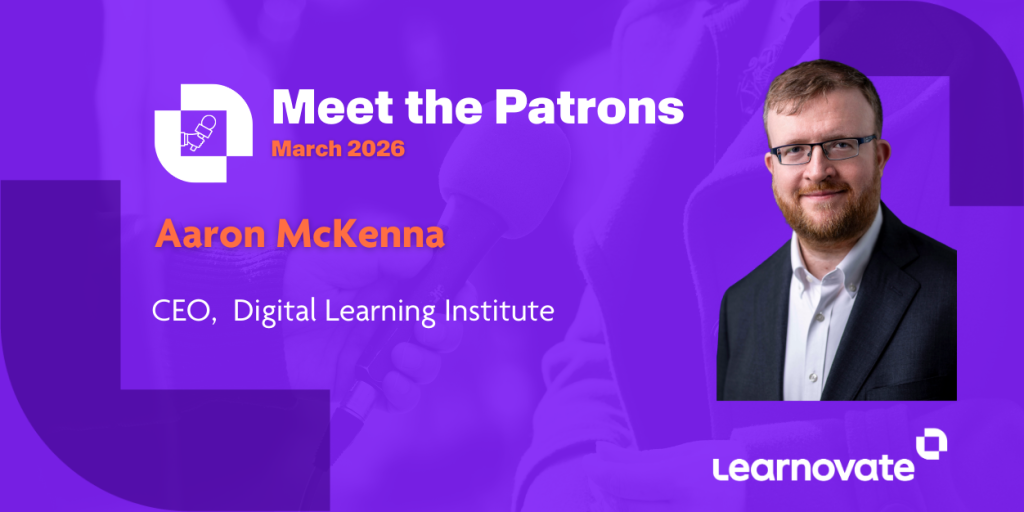
Meet the Patrons
Meet the Patrons interview with Aaron McKenna
For the latest in our Meet the Patrons series, we speak to Aaron McKenna, CEO of Digital Learning Institute, a global digital learning provider with a focus on AI upskilling programmes.
- Meet the Patrons
Aaron began his professional life as a freelance technology journalist but joined a startup, TG Publishing, in 2005. Over the following ten years, he went on to hold senior leadership roles in the technology, e-commerce, and digital education sectors, including a six-year spell at the Digital Marketing Institute.
In 2019, he founded the UCD Professional Academy, now the university’s largest trading subsidiary. He joined the Digital Learning Institute in June 2023.
What are the biggest lessons you learned in your career?
I’ve been in businesses that are going great, and in businesses that are going terribly. The biggest lesson I’ve learned is: don’t get too overly excited when something goes right because it took a lot of work to bed that in. Likewise, don’t get excited when things are going sideways because you’ll learn from it and, as a leader, people take their cues from you. A mentor once told me: ‘Every business is a people business. It is a group of people who wake up on Monday morning and decide to show up to work and decide to work together. If you treat them right, bring them together and give them a clear idea of what’s going on, you’re going to get the best out of them.’
How would you define your work style and how has it changed over your career?
The nature of my job now is different to 20 years ago. I used to be a super-energetic guy in the weeds who constantly felt like I had to prove myself. Before we sold it, I was in a startup that was never more than two months away from going out of business. I had to get down into the weeds on things and I would drive it with a great deal of energy.
Becoming a CEO, I had to elevate my thinking. Ultimately, if you outline a strategy and sell it to them, your staff will do it – even if it’s a bad strategy. I’ve seen businesses where executives or founders can’t help becoming involved in particular areas. They will look at what their people have done and said, ‘I wouldn’t have done it this way’. The senior person then becomes a bottleneck. The right approach is to hire the right people, give them the right tools and trust them.
If you hadn’t chosen your current career, what would you have done instead?
I would have stayed working as a journalist, writing about technology companies and going to tech conferences. They were great days. Now the world of journalism is a lot tougher. Former colleagues tell me, ‘I’d love to be doing what you do now’. The grass is always greener, but the industry I remember from the early 2000s, I loved.
How is AI impacting your industry?
More people are learning about AI than are using it effectively. Everyone has to adapt to keep up with the pace of change, whether it’s the technology itself or the compliance demands that come with the tech. As a certification provider, we have to incorporate those things into our courses and I think we’ve been very successful at that.
My wife was on maternity leave recently and disconnected from the world of work. I noticed how organically she slipped into asking chatbots questions rather than Google. That is going to be a hugely significant development, one you have to stay on top of because the guys in online media were heavily disrupted by Google, social media and so on – and now that world is going to be heavily disrupted. Maybe Google and social media companies lead out on that, and maybe they’re the winners at the end of the day, but it certainly feels that the business model is changing significantly.
What are the opportunities and risks from AI to your business or sector?
There’s a lot of hype. If it happens that AI replaces workers and ends up doing everything, as a business we’ll move to teaching people to do whatever they’ll be doing with all their free time. That likely won’t happen. Computers were supposed to have us working a two-day week by now. How’s your two-day week going? At the very least, AI tools will improve productivity and enable us to do new things in new ways. If your productivity growth is 1% a year, it might make your growth 2-3% a year. That’s pretty significant. There are guys saying, ‘No, growth is going to be 100% a year’. I’m not buying it yet.
What new trends or technologies are changing how people learn? How is your organisation responding to this?
The meta trend is that people’s time and patience for learning is getting shorter. Attention spans in general are getting shorter. People are always thinking of doing courses but deciding not to. If you ask why not, they will often say that time is the biggest barrier. They want shorter courses. They want bite-sized learning that’s impactful at the time that they need it.
What are the biggest skills challenges in your sector?
Perhaps it’s always been like this but I speak to people in learning and development and universities and they’re struggling with the current generation because they’re so culturally different which means they learn in a different way. That’s been exacerbated by the pandemic. From a business point of view, keeping up with that is a huge challenge because you need to get a 40-something-year-old instructional designer to think like an 20-something-year-old who spent most of secondary school sitting in their bedroom.
What book would you recommend on learning, technology, business or understanding people?
Measure What Matters. OKRs: The Simple Idea that Drives 10x Growth by John Doerr.
It describes this system of Objectives and Key Results (OKRs). It’s a system that’s used across Amazon, Google, and a whole bunch of tech giants. Measure What Matters is an engaging book, but it doesn’t just give you a framework for work, it gives you the ‘why’ behind it. I’ve implemented this from the ground up in a few organisations and many I’ve work with says it changed their life.
Why is membership of Learnovate important to your company?
Learnovate is really good on the R&D side. They’ve got a great team if you want to get them involved in a project. There’s a lot of good stuff going on in there. On a more meta level, Learnovate is important for creating a space where people can come together and share. I spoke at one of their events before we became a patron member. It was fantastic in that it brought together people to share ideas and best practices and talk about the things that are and are not working for them. They bring the thought leadership piece and I think that’s super important, especially nowadays.
Exclusive content for our members
If you're already a member, please sign in now to continue.
Or contact our team to find out more.