
Meet the Patrons
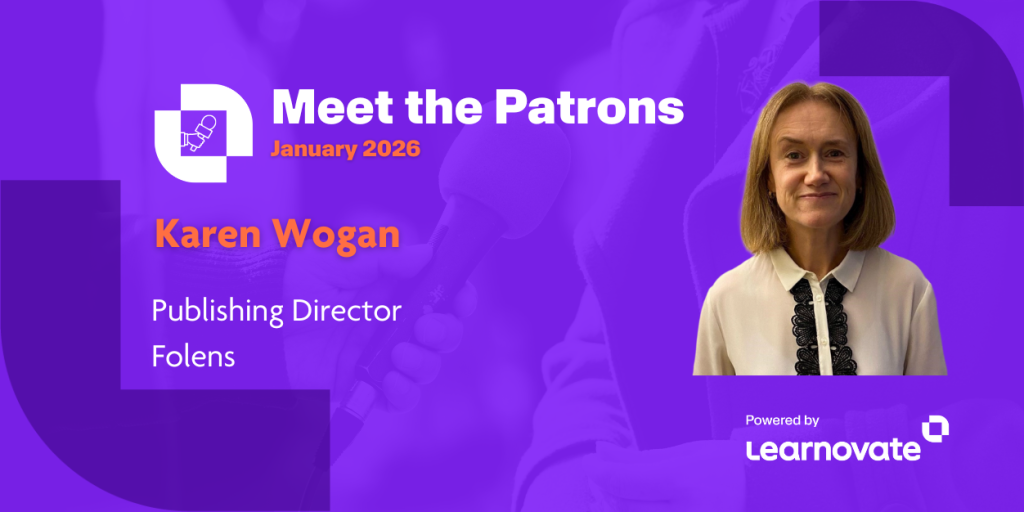
Meet the Patrons interview with Karen Wogan, Publishing Director with Folens
Karen’s career began more than 20 years ago when she joined an instructional designer at Dublin digital publishing firm Riverdeep. She remained there for a decade, during which time she saw the company grow from a small startup to a multinational, Houghton Mifflin Harcourt (HMH), following a reverse takeover of major US publishers.
- Meet the Patrons
Karen spent five years with a HMH spin-off firm EMPGI before joining Folens in 2013, progressing from Commissioning Editor to Head of Primary. She is now the Publishing Director overseeing strategy, learning design, and editorial direction across both primary and post-primary education.
What are the biggest lessons you learned in your career?
Forward planning is really critical educational publishing. You’re conceiving and developing a product two years in advance of it going to market. Someone once advised me, ‘Do it well once, plan ahead, and then you won’t be picking up the pieces two years later’. Another key lesson has been the shift from specialising to generalising. When you’re working for a big company, as I was before, you can be a specialist in one particular area. In an SME like Folens, you need to have oversight of a much broader range of functions. That requires discipline, planning, and the ability to join the dots across multidisciplinary teams which is both challenging and rewarding
How would you define your work style and how has this changed over your career?
I’ve always been flexible and creative and that’s been consistent throughout my career. What has changed is the emphasis I place on communication. Earlier in my career, I had been working in a specialist area of a large organisation so there wasn’t the same need for me think about how I communicated across teams. Now, particularly as a director, I need to be much more conscious of how I communicate to the rest of the team.
Folens has a wide range of functions: commissioning, editorial, supply chain, sales, marketing, accounts, customer service, technology, and EdTech. All of these teams need to stay aligned, but everyone is incredibly busy. I think it’s really, really important that teams understand how their work connects with other departments to ensure that people don’t end up working in silos.
What have you learned about managing teams and individuals?
Effective management starts with recruitment. Finding the right people for your business and your culture is critical. You can have somebody who can excel in one environment, but who doesn’t necessarily do so in another, so being conscious of company culture is as important as technical fit. It’s also important to align people’s strengths with the work. If I’m planning publishing projects, I look at people’s strengths and weaknesses and assess who is going to be the best fit for that particular task. That’s what sets you up for success: get the right person in the right role from the get-go. It leads to better outcomes for the organisation and a far more positive experience for the individual..
What advice would you give to your younger self?
Trust your instincts and speak up early. When I was younger, I didn’t place enough faith in my own judgment when I should have. Backing myself would have served me better.
How has AI impacted your organisation/industry?
The impacts are both positive and negative. On the positive side, the potential for more personalised learning, adaptive assessment, and dynamic feedback is huge. That could be really, really powerful. On the other hand, there are concerns that generative AI brings risks around low-quality content, over-reliance on LLMs and the impact on children’s attention spans.
We have all these tools, but it doesn’t necessarily translate into better learning. Reflective, deep thinking – which can often come from sitting on your own with a book without any distractions – can be powerful. That can get lost in the conversation about the great leaps forward we’re making in technology and innovation. Our brains haven’t evolved at the pace of technology, so how AI is integrated into education will really matter. Hopefully we’ll manage it in a way that has less harmful impacts than, say, social media on young children — but that’s often not under the control of publishers. It’s in the hands of tech companies.
What are the opportunities and/or risks from AI to your business or sector and/or the learning technology industry?
Teachers struggle with time constraints and the diversity of needs in a classroom. Differentiating for a wide range of abilities and being able to deliver learning to every child at their own level is a major challenge. If AI can help assess a student’s understanding, identify gaps, and provide targeted support, that’s going to be really helpful for teachers. Likewise, children learn in different ways. Some might be fine learning independently. Others might learn better in groups or by doing something in a more hands-on way. There’s definitely potential with AI to support with more personalised learning. But you also don’t want to see kids just passively sitting staring at a screen all day. Learning is a social process and social interaction is important for developing cognitive skills.
What are the biggest skills challenges to your business or sector?
Educational publishing is a niche industry in Ireland so, finding people with relevant experience is a big one. There are a very small number of publishers in Ireland, so if you’re looking for somebody with direct experience, they’re usually already working for one of the other companies or you’re trying to recruit somebody and investing time and effort in training.
You’re also competing with multinationals for graduates who might be drawn to the salaries and prestige of technology companies like Google or Facebook. However, despite all that, we continue to attract talent because people are interested in the kind of company we are and the work we do. We’re a more vocational industry in the sense that people who tend to work in education have some passion for it.
How can third level address the skills gaps/challenges you are facing?
Third-level institutions train teachers and we have recruited graduates from teacher training who have gone on to work as commissioning editors and that educational background is incredibly valuable. However, there is a broader challenge for wider industry with graduates coming out without some of the technical skills that companies are looking for, like data analytics.
At the same time, we shouldn’t lose sight of the value of the humanities.. You need people who are creative, critical thinkers. The danger is that in getting third-level to address the technical skills gaps across industry, an appreciation for soft skills gets lost in the mix.
What book would you recommend on learning, technology, business or understanding people?
Thinking, Fast and Slow by Daniel Kahneman. This feeds into my psychology background and I found it really insightful in terms of exploring how we make decisions. We assume that we’re rational in our decision-making and behaviour, but we over over-estimate our rationality.
What are your favourite tools and resources in work?
ChatGPT is one of my most useful day-to-day tools. It’s really helpful in terms of shaping an unstructured piece of content and for analysing material quickly. I wouldn’t ever take its outputs wholesale, because things like accuracy, structure and tone need oversight and an authentic voice is important. But in terms of structuring and organising ideas it can be really helpful.
Any interesting podcasts or other media do you consume that you would recommend on learning, technology or business?
I listen to a podcast called Pivot – it’s a podcast covering politics, economics and culture hosted by a journalist, Kara Swisher, and a professor of marketing, Scott Gallaway. I also subscribe to a Substack by an economist called Noah Smith. He’s from the US and, again, he writes about things like technology, economics, geopolitics and wider cultural trends. While it’s not specific to education, it’s useful for understanding the broader environment in which we all operate.
Why is membership of Learnovate important to your company?
We recently attended the 2025 Learnovation conference where it was interesting to hear about Learnovate building partnerships with learning hubs in other European countries. That kind of collaboration is really valuable because it prevents companies from being too inward looking and opens us up to other perspectives. Membership of Learnovate also keeps us abreast of what’s going on in learning and development more broadly. From an R&D perspective, having access to a team that actually has the time, expertise and resources to explore research emerging ideas that we may not be able to do ourselves is a real positive.
Exclusive content for our members
If you're already a member, please sign in now to continue.
Or contact our team to find out more.