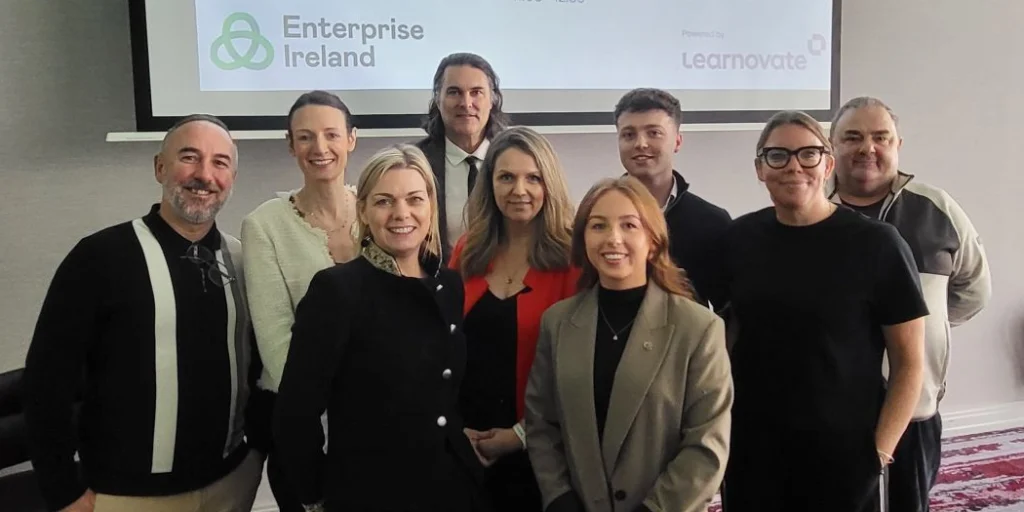
As skills-based hiring, AI-driven change and new governance requirements reshape the world of work, professional education is under growing pressure to adapt. At a Learnovate and Enterprise Ireland brunch held during Bett 2026 on 22 January 2026 in London, leaders from across EdTech, assessment and governance came together to discuss what’s changing — and what educators, employers and learning providers need to do next.
Why Skills Are Replacing Qualifications as the Primary Signal
As the panel discussion made clear, employers are increasingly asking f or evidence of what people can actually do — not just the qualifications listed on their CVs. At the same time, universities and training providers are under pressure to respond to rapidly changing industry needs, particularly in areas such as AI, cybersecurity and digital governance. These tensions framed the conversation at the Learnovate and Enterprise Ireland brunch, where a standing-room-only audience explored how professional education needs to evolve.
Meet the Panel: Perspectives from EdTech, Assessment and Governance
Moderated by Enterprise Ireland’s UK Market Executive, Rose Goggin, the panel included Dr Peter Gillis, Innovation Services Lead at Learnovate; John Duggan, Head of Partnerships at the Corporate Governance Institute; and Kate Hake, Senior Product Manager at Learnosity. While the discussion covered skills, assessment, governance and technology, a clear message emerged early on: the future of professional education is not about choosing between qualifications and skills, but about connecting them more effectively.
The T-Shaped Professional: Balancing Depth and Transferable Skills
Peter Gillis highlighted a challenge many employers recognise: “Every graduate comes out with the knowledge, but doesn’t have the skills to be productive from day one.” Rather than reducing academic depth, Gillis argued for designing education around the “T-shaped professional” — deep subject expertise combined with transferable skills such as collaboration, communication and problem-solving. Industry-led initiatives like ServiceNow’s skills components were cited as examples of how employers are supplementing formal education where institutions struggle to keep pace.
Who Is Responsible for Professional Development?
This shift raises an important question about ownership. Is professional development the responsibility of individuals, employers or professional bodies? John Duggan pointed to growing requirements around environmental, social and governance (ESG), technology governance and cybersecurity, which are placing increasing responsibility on organisations themselves. In many cases, leaders will be expected not just to have experience, but to demonstrate recognised competence.
Why Assessment Is Central to Skills-Based Education
Assessment emerged as a central theme throughout the session. With AI accelerating change and learners expecting applied, flexible learning experiences, traditional exams and slow curriculum approval processes are increasingly misaligned with industry needs. How skills are assessed, validated and trusted — by employers, professional bodies and learners — remains a critical challenge.
The Growing Gap Between Education and Industry
Several panellists highlighted the widening gap between the pace of industry change and the speed at which formal education systems can adapt. Curriculum approval timelines of three to five years, combined with lengthy regulatory processes, often leave graduates well prepared in theory but out of date in practice, particularly in fast-moving areas such as AI, cybersecurity and technology governance.
Industry–University Partnerships as a Practical Solution
John Duggan described how the Corporate Governance Institute addresses this challenge through partnerships with universities such as Queen Mary University of London. By accrediting specific modules while providing students with access to continuously updated industry content — including webinars, discussion groups and governance frameworks — learners can engage with current practice alongside their academic studies.
Two Credentials, One Graduate: Degrees Plus Skills Validation
Peter Gillis outlined Learnovate’s research into a model where graduates leave with “two pieces of paper”: a traditional degree alongside a complementary skills credential, potentially validated by industry partners. This approach avoids lengthy academic approval cycles while giving learners a way to demonstrate applied and human skills. In the S21C project, peer assessment is used to evaluate human skills, while academic institutions retain responsibility for disciplinary accreditation.
Moving Beyond Multiple-Choice Testing
Kate Hake discussed the limitations of traditional multiple-choice assessments in a world where employers want evidence of application rather than recall. She argued for assessments grounded in real-world contexts, such as coding in live environments, navigating simulated conversations, or solving authentic workplace problems.
Continuous Assessment and Lifelong Learning
Rather than relying on a single high-stakes exam, Hake highlighted the value of continuous assessment: ongoing opportunities for learners to demonstrate competence, receive feedback and improve over time. This approach aligns with lifelong learning, where skills development is iterative and careers evolve over decades.
Why Human Skills Still Matter in an AI-Driven World
Alongside technical and digital capabilities, the panel repeatedly emphasised the importance of human skills. Creativity, collaboration, resilience and emotional intelligence were all identified as enduring priorities, even as automation and AI reshape job roles. Gillis captured this challenge as learning to “use AI and not get used by it”.
Multidisciplinary Learning and Project-Based Education
Audience questions broadened the discussion to multidisciplinary learning and the limits of traditional subject silos. While a fully polymath university model may be ambitious, there was agreement that project-based learning — including hackathons and real-world problem-solving — offers a practical way to develop human and technical skills together.
Curiosity, Critical Thinking and Learning Through Dialogue
Curiosity and critical thinking also emerged as skills in need of renewed emphasis. Gillis pointed to the value of Socratic questioning, supported rather than replaced by AI tools, as a way to develop deeper thinking. Duggan added that discussion groups and peer engagement play a similar role in professional learning and are recognised as part of continuous professional development.
Designing Learning for Today’s Learners
The panel acknowledged that learner expectations have shifted. Long, passive content formats are being replaced by shorter, more interactive experiences. As Duggan noted, “the 40-minute video is definitely gone.” Learners increasingly expect multimodal content and opportunities to engage with peers, making community-driven learning platforms an important part of modern education design.
What’s Next for Skills, Governance and Professional Education
Looking ahead, the panellists were broadly aligned. Project-based learning is likely to become more embedded within traditional courses. Governance requirements around ESG, AI and cybersecurity are expected to shift from optional to mandatory under UK and EU regulation. Assessment methods will continue to evolve, with greater emphasis on applied competence and demonstrable skills. Partnerships between education providers, employers and professional bodies will be increasingly central.
Continuing the Conversation Beyond Bett 2026
Peter Gillis closed by noting that conversations begun at Learnovate events are already leading to more concrete collaboration. An education and innovation testbed consortium first discussed in October is progressing, with further updates expected later this year, including at Learnovation 2026 in October at the Aviva Stadium in Dublin.
About This Blog Post
Gavin Henrick, co-founder and CEO of Brickfield Labs, was among the members who attended the Bett Brunch co-hosted by Learnovate and Enterprise Ireland in London on 22 January 2026. Gavin used Brickfield’s AI-supported technology to transcribe the panel discussion, Skills, Governance, and the New Professional Landscape, and to help shape this blog — offering those who could not attend a detailed view into the ideas and insights shared on the day.